5.11.12

Ten plants from Traditional Health Program


These is the ten medicinal plants that the Philippine Department of Health (DOH) through its “Traditional Health Program” have endorsed. All herbs have been thoroughly tested and have been clinically proven to have medicinal value in the relief and treatment of various aliments:


Cassia alata  


1.     Cassia alata  (Akapulko)– also known as “bayabas-bayabasan” and “ringworm bush” in English, this herbal medicine is used to treat ringworms and skin fungal infections.


bitter melon


2.     . Momordica charantia  (Ampalaya) – known as “bitter gourd” or “bitter melon” in English, it most known as a treatment of diabetes (diabetes mellitus), for the non-insulin dependent patients.


garlic


    3.  Allium sativum  Bawang – popularly known as “garlic”, it mainly reduces cholesterol in the blood and hence, helps control blood pressure.


guava


4.     Psidium guajava  (Bayabas)  – “guava” in English. It is primarily used as an antiseptic, to disinfect wounds. Also, it can be used as a mouth wash to treat tooth decay and gum infection.


  Vitex negundo


      5.  Vitex negundo ( Lagundi) – known in English as the “5-leaved chaste tree”. It's main use is for the relief of coughs and asthma.


Quisqualis indica 


6.     Quisqualis indica L(  Niyog-niyogan ) – is a vine known as “Chinese honey suckle”. It is effective in the elimination of intestinal worms, particularly the Ascaris and Trichina. Only the dried matured seeds are medicinal -crack and ingest the dried seeds two hours after eating (5 to 7 seeds for children & 8 to 10 seeds for adults). If one dose does not eliminate the worms, wait a week before repeating the dose.


Blumea balsamifera
     

    7.  Blumea balsamifera  ( Sambong )- English name: Blumea camphora. A diuretic that helps in the excretion of urinary stones. It can also be used as an edema.


 Ehretia microphylla


8.     Ehretia microphylla Lam (.Tsaang Gubat ) – Prepared like tea, this herbal medicine is effective in treating intestinal motility and also used as a mouth wash since the leaves of this shrub has high fluoride content.


Peperomia pellucida


   9.     Peperomia pellucida  (Ulasimang Bato ) – also known as “pansit-pansitan” it is effective in fighting arthritis and gout. The leaves can be eaten fresh (about a cupful) as salad or like tea. For the decoction, boil a cup of clean chopped leaves in 2 cups of water. Boil for 15 to 20 minutes.Strain, let cool and drink a cup after meals (3 times day).


Peppermint


10.   Clinopodium douglasii (Yerba Buena) – commonly known as Peppermint, this vine is used as an analgesic to relive body aches and pain. It can be taken internally as a decoction or externally by pounding the leaves and applied directly on the afflicted area.


26.9.12

Yes ! .... GMOs have adverse effects... the proof...


Monsanto does not authorize the use of its genetically modified seeds (GMO Maize, rice, rape ... and many other for scientific without knowing the purpose of the research.
Monsanto requires that receiving and evaluating research results before their publication
Monsanto prohibits the publication studies whose results is contrary to expectations
Monsanto .... And other GMO producers .... !


It is in the utmost secrecy, that this study was conducted, no document, no email, no phone call did not mention the existence of this study.

Although 'secret', this study was conducted in accordance with standards of good laboratory practice (GLP), it meets all the specifications that the FDA requires for the Evaluation of Medicinal Products before placing on the market (are more investigations for this study as those required for food products and processing)
Corn is not the only one concerned ... rice also

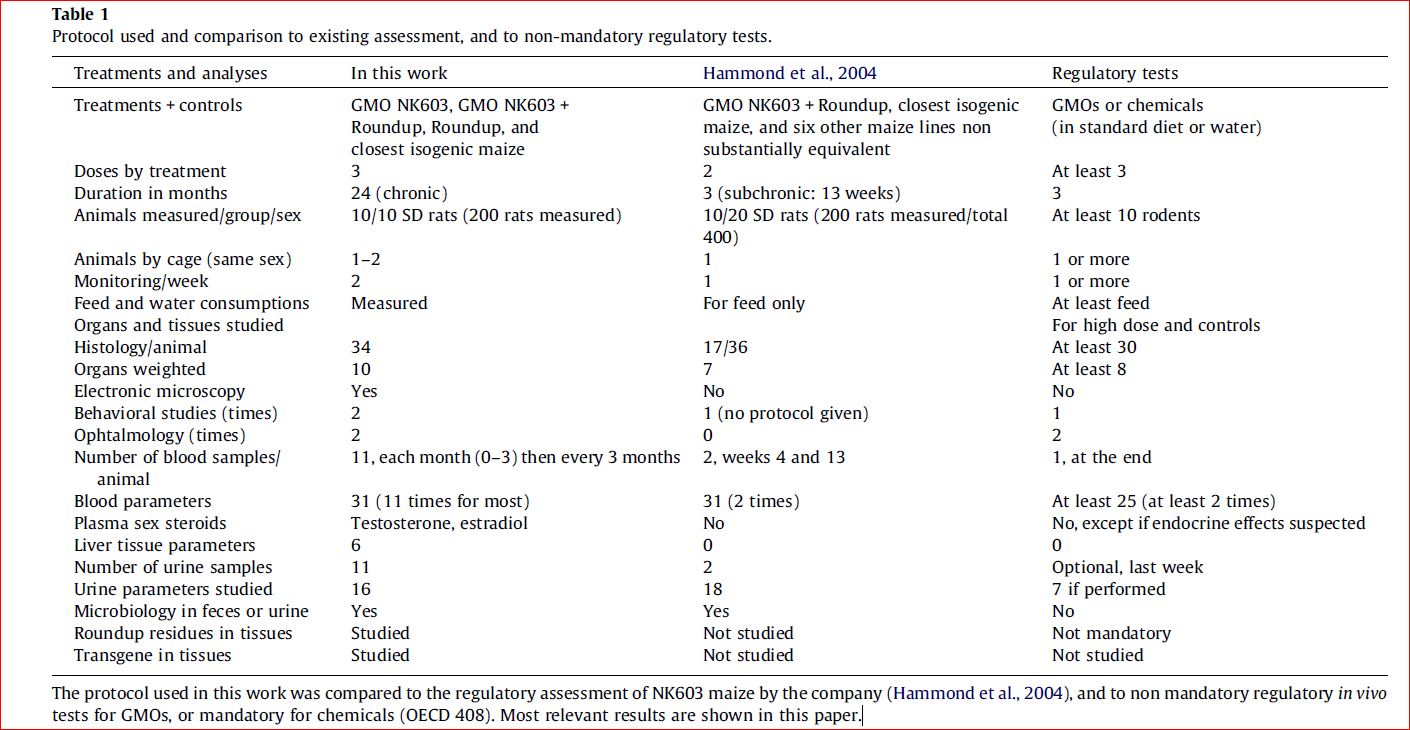
Studies requirements ( click to enlarge)

 It was found that both the environment and gene manipulation had remarkable impacts on the contents of glycerol-3-phosphate, citric acid, linoleic acid, oleic acid, hexadecanoic acid, 2,3-dihydroxypropyl ester, sucrose, 9-octadecenoic acid (Z)-, 2,3-dihydroxypropyl ester and so on. Sucrose, mannitol and glutamic acid had a significant increase in transgenic grains in contrast to those in non-genetically modified (GM) rice  J Chromatogr B Analyt Technol Biomed Life Sci. 2009 Mar 15;877(8-9):725-732. Epub 2009 Feb 5.
Chemical name of Roundup : glyphosphate…

Kidney inguries  (click to enlarge)
The health effects of a Roundup-tolerant genetically modified maize (from 11% in the diet), cultivated with or without Roundup, and Roundup alone (from 0.1 ppb in water, or , 0,1 ml per cubic meter), were studied 2 years in rats. In females, all treated groups died 2–3 times more than controls, and more rapidly. This difference was visible in 3 male groups fed GMOs. All results were hormone and sex dependent, and the pathological profiles were comparable. Females developed large mammary tumors almost always more often than and before controls, the pituitary was the second most disabled organ; the sex hormonal balance was modified by GMO and Roundup treatments. In treated males, liver congestions and necrosis were 2.5–5.5 times higher.

 This pathology was confirmed by optic and transmission electron microscopy. Marked and severe kidney nephropathies were also generally 1.3–2.3 greater. Males presented 4 times more large palpable tumors than controls which occurred up to 600 days earlier. Biochemistry data confirmed very significant kidney chronic deficiencies; for all treatments and both sexes, 76% of the altered parameters were kidney related. These results can be explained by the non linear endocrine-disrupting effects of
Roundup, but also by the overexpression of the transgene in the GMO and its metabolic consequences.

the video that explain all the study


Long term toxicity of a Roundup herbicide and a Roundup-tolerant genetically modified maize Read the full text


"The statutory tests are over 3 months and large pathological particularly dead rats by tumor arrive at the fourth month," says Dr. Spiroux, co-author of the study and chairman of the committee that spearheaded the CRIIGEN. "It means that the regulatory tests of three months (as required by the FDA) are ineffective to mark the impact on health treatment GMO or GM food in the long term in life"
No manufacturer or producer realizes additional test requirements of registration bodies (in all areas) under the authorization of use there is no control.


what about this?
trying to forget all the ads that tout the merits of this or that plant! The good products are differentiated by their qualities, not advertising!
so ... a little common sense                                              


GMOs are useful for some specific purposes, such as generating drug, the depolution, certain industrial processes. These uses, interfering little or no human health.Medications are absorbed on a low dose, and for limited periods
feeding is daily… for lifetime ..
The modification, minor, without noticeable effects in the short or medium term may have significant consequences, and irreversible long-term

who is willing to take the bet ... against himself
,
just common sense

15.9.12

Marijuana and Politics .... Where is the common sense?


If you like --> G+1

Marijuana has been used for thousands of years as a sovereign remedy for all civilizations.

In the 19th and the first half of the 20th century, it was regarded as irreplaceable by the medical profession.

Like its cousin hemp, it is free to produce. Its use is simple, no irreversible side effects.
1920, with the rise of chemistry, appeared  pharmaceutical specialties synthetic drugs. New panacea!
Panacea? My god no! 
Synthetic drugs one after the other, have proved negative and was withdrawn from sale.
In the 60s our society has evolved rapidly, it was a technological, social and cultural evolution, a questioning of the reason for living, a questioning individual.
And stress appeared!
 Marijuana has been (re) discovered as a treatment for stress (read testimony)

Politicians have let it happen, it served their purposes, population stress-free and responsive.
Everyone was a winner! Except ... the pharmaceutical industry ...

She orchestrated to politicians smear campaign marijuana

Everything was good lobbyists, campaign financial support, action stigma, collusion ...
Pharmaceutical companies have achieved their goal with the president R. Nixon in the war against hard drugs and trafficking (heroin and others).


This against the advice of the medical profession marijuana has been included in Annex I, under the pressure of big pharmaceutical trusts.
Only the action of recreational marijuana was considered.
In defiance of wholes other directions!

In defiance of the effectiveness of marijuana cons of multiple conditions, each week, the medicine discovers new therapeutic indications of marijuana.


In recognition of this medical and absurdity of the legislation, some States, under the pressure of citizens, authorized and supervised use of medical marijuana.
This is the case of  MICHIGAN, or rather, it was!

For reasons of financial interests, in collusion with questionable commercial firms, electoral politics of the lowest, Politicians, dimly lit by their peers (a small group of corrupt) are willing to make more restrictive the use of marijuana medical.
The new legislation, if approved, will treat patients as criminals! (read more here)
In total negation with the will of voters, who approved by a large majority (63%) the use of medical marijuana.
MICHIGAN citizens, just common sense, support the sick, let the patient treat with dignity.
Show your common sense by participating in the rally on 19 September LANSING!

Common sense and solidarity!

read more:

8.9.12

Nettle: His unknown qualities, part I

If you like  click G+1 -->
Botanical Name Urtica dioica L.
Common name: Nettl

Botanical characteristics
Nettle has a creeping rhizome perennial, with numerous rootlets. In the spring, it gives rise to rods 30 to 150 centimeters in height. They are quadrangular, unbranched and equipped with short hair and long stinging hairs. Short hairs are unicellular, thick-walled, while the wall structure has a stinging hairs brittle and fragile. Their point break at the slightest touch, and sinks into the skin, where it injects its contents directly stinging, causing a painful sensation.
Leaves opposite the toothed rim, are oval or lanceolate, the petiole, are heart-shaped or rounded. Each sheet has two stipules at the base of the petiole. The inflorescences are generally composed of male and female flowers, borne on different feet. The stinging nettle is a dioecious plant. Anemophilous flowers are inconspicuous green. In the female flowers is a superior ovary with large scars shaped brush. The fruit is a small nut seeded. The male flowers have four stamens straighten at once to the outbreak of the flower, releasing a cloud of pollen. Flowering occurs from July to September.
Small nettle or Urtica urens, with more virulent poison, does not stand frost.
Nettle is a cosmopolitan plant found in temperate regions of the world. This is a ruderal plant, meaning that it appreciates the polluted areas, it is in charge of clean up. As plant nitrophilic it follows the human culture and grows especially well on soils contaminated by fertilizers and feces of men or animals. It occurs most often in areas of unspoiled nature. For cons, the presence of nettles can be recognized long after their abandonment and neglect, places that were once occupied.
Nettle, also called iron plant in the first degree, regulates the iron content of the soil, and is thus beneficial for all other plants that grow there. Indeed, the presence of iron is required for the production of chlorophyll pigment green parts of the plants.

A medicinal plant

In the past
In Switzerland, we found remains dating from the 3rd century BC., In lake cities, dating Neolithic times.
The ancient Greeks identified it as the name acalyphe. The name comes from Latin urtica urere which means "to burn." Dioica, French dioecious, says plants with male and female flowers are on separate feet.
Greek physician and botanist Dioscorides (born in 40) also considered the virtues of nettle which he described in detail the use.
Physician and botanist Otto Brunfels wrote in 1532 in his book of the simple: "What could be more trivial, more despicable or more detestable than a nettle. What is more graceful than hyacinth, a rose or a lily - and yet, nettle tops them all." Lonicerus wrote that she was" burning early in the first degree and dry in the second. " It would the effect of stimulating menstruation, soften, expel gas, calculations and urine, it would also be an aphrodisiac and would use against cancerous tumors, gangrenous wounds, boils, ulcers , glandular swellings, sprains, bleeding from nose, spleen disorders, pleurisy and pneumonia, asthma, ringworm, oral disease and epilepsy. Nicholas Culpeper, the famous English physician of the first half of the seventeenth century, recommended to treat diseases of the blood vessels and airways.
In the 18th century, it was used successfully against dropsy, all forms of bleeding and rashes. Nettle also played a role as a "cure sympathetic." We proceeded readily to flogging members with rheumatism or paralysis with a bunch of nettles, poison contained in the leaf hairs causing irritation of the skin, followed by redness and sometimes blistering.
In Ayurvedic medicine (traditional medicine of India), is employed nettle in combination with other plants to treat uterine bleeding, nosebleeds, rashes and eczema.
Native Americans use it to relieve rheumatic pain and to support women during childbirth.
In Morocco, the nettle is used to treat hypertension.

In the kitchen

In Europe, we consume nettle, willingly soup or salad, and there was even a time when the infusion was much appreciated in the society salons. With dandelion 
a link to an excelent article greens and other spring greens, nettle seedlings were part of the "spring cures" that were once so popular. Note that the power of stinging nettle hair is inactivated by cooking and drying

In farming


Organic farming uses nettle as a fertilizer, as a protectant, plants and to promote the formation of compost. Dried nettles are an excellent fodder. It is also used for obtaining fibers


Unexpected uses

The food industry uses nettles. Chlorophyll is green dye to improve the appearance peas and beans cans.


The Amerindians used the nettle in their rituals: The dreamcatcher was braided fiber cloth nettle or tendons of animal , they then dyed red using bark wild plum.